From SEO to AEO: Eight steps to increase your visibility
Has AI made SEO obsolete? No, but the rules have changed. Not just what is written, but also how the content is structured matters. AI prefers pages that provide precise answers early on and deprioritizes those that bury the answer deep within the text.
In four years, the way we search for information has changed dramatically. From keywords in a search bar followed by clicking and exploring, to asking full questions to Gemini, ChatGPT, Perplexity, or another AI tool, with the expectation of getting the answer directly.
Does this mean we have to completely change how we write and structure content? Not necessarily, but some adjustments can pay off. It can be smart to present the answer early in the text and to write paragraphs that make sense on their own, detached from the rest of the article.
What should you focus on?
Cyrus Shepard's analysis of 400 websites that have survived what he calls "the great traffic apocalypse of 2024-2026", points to several common traits among the winners: They offer a clear product or service, they allow the user to perform a task, they had content no one could copy, and they have built strong brands. The conclusion is important: AI rewards sites that are good at SEO.
- Write for people with a specific question Answer early in the text, be clear, and improve the quality of your language, because it counts even more now. AI engines are trained to recognize content that is clearly formulated, precise, and independent. By independent we mean a sentence that makes sense when detached from context, which the AI can use directly as an answer. Break the content into short paragraphs that each answer one sub-question.
- Elevate the answer Give the answer first and elaborate afterward. Aja Frost, Director of Global Growth at HubSpot, says the following to EMARKETER: "...the first sentence on a page should answer the main question completely, because AI engines are looking for that quick confirmation."
- Answer what people are wondering about The structure should mirror how people actually ask questions. Headings like "What is X?", "How do I do Y?", or "How much does Z cost?" work well precisely because they reflect the way questions are phrased. This makes it easier for AI to pick out the exact paragraph as an answer.
- Establish an FAQ An FAQ with questions and answers based on what people are actually wondering about increases the chances of being cited by AI. The very best approach is to use real questions from users and customers. Employees who work in customer service and sales are excellent sources for this.
- Write content no one can copy Once the content is structured, you must ensure it is worth extracting for an AI. What everyone else is already saying does not make your website competitive. Content built on your own experiences, professional expertise, or data that no one else has is content that AI must cite, because it doesn't exist anywhere else.
- Keep content updated AI-cited content is on average 25.7% fresher than content that ranks highly in traditional Google searches.* Figures and facts should be updated so that the content reflects what is true today. The same principle applies to new content: regular publishing signals an active and updated website, which AI systems seem to reward, at least for the time being.
- Build visibility outside your own website Visibility outside your own website is important, just as it is with traditional SEO. Mentions on professional websites, industry organizations, and other relevant sites increase the chance that your website will be chosen as a source when AI looks for authoritative voices.
- Ensure the site is in good technical condition Good page speed and clear structure are of great importance. Schema markup is valuable in many SEO contexts, but another recent study conducted by Ahrefs shows that adding schema has no measurable effect on AI citations. What counts is the whole: good technical maintenance, good content, and authority.
This is the difference between SEO, AEO, and GEO
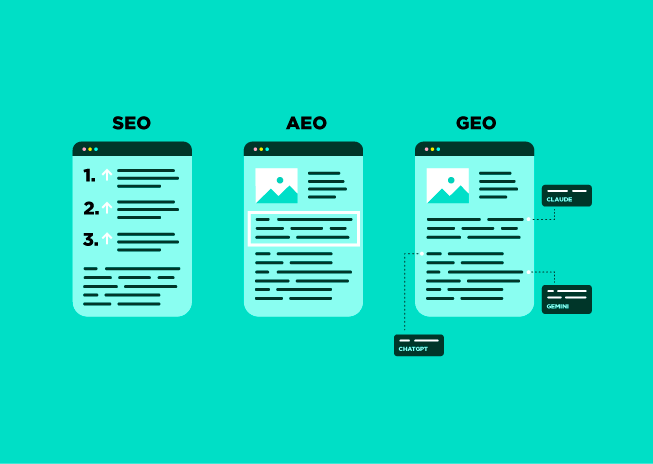
SEO (Search Engine Optimization) is about convincing search engines that your website is relevant and has the authority to rank highly in search results. Success is measured by position in search results and clicks to the website. (SEO today encompasses more than this, but we are sticking to the simple explanation.)
AEO (Answer Engine Optimization). Here, the goal is for the content on the website to be retrieved directly as an answer to a question, such as what we see in Google's featured snippets. Short, precise answers to specific questions are rewarded, often based on FAQs and structured data.
GEO (Generative Engine Optimization) is similar to AEO, but specifically targets large language models like ChatGPT, Claude, and Gemini. The goal here is for your website to be used as a source when these models provide comprehensive and synthesized answers.
How does AI choose sources?
Several studies have been conducted on how AI selects its sources. A significant body of data is beginning to emerge, and more will follow in the future.
Growth Memo conducted two studies that analyzed over 800,000 queries and their corresponding pages. The studies showed that long, all-encompassing guides perform worse than shorter, more focused pages. ChatGPT did not reward breadth, but rather precision.
Another observation from the same study, which Search Engine Land has also highlighted, is that nearly half of all citations are pulled from the first third of the content. If you don't get to the point quickly, there is a high chance your content will be overlooked by AI.
Ranking isn't everything
A high ranking on Google is no guarantee of being cited by AI. A study from Semrush shows that nearly 90% of the pages ChatGPT cites rank in position 21 or lower in a traditional Google search. At the same time, some AI models cite pages that rank in the top 5 more often than pages in positions 6–20. You can therefore be cited with a weak ranking, but a top 5 spot in Google still provides an advantage.
AI prefers authority
It is also not the case that all studies point in the same direction. A review of 68 million visits from AI crawlers across more than 850,000 websites (Duda, 2026) showed a clear pattern: AI crawlers do not visit weak websites to lift them up; instead, they return to websites that already have authority and high traffic. In other words: good visibility in traditional search engines remains important, both for attracting human visitors and for being picked up by AI.
Brand preference drives traffic
The picture is not entirely negative for website traffic. Data from Amsive shows that so-called branded queries (branded queries), i.e., searches where the user already has some knowledge of the source, see an 18% increase in click-through rate when AI Overviews appear in the results. People are clicking through to sources they know and trust. This underscores the importance of building a brand and awareness over time.
A recurring theme in the research is that a website must be fast and that both structure and content must be well-organized. The technical aspect of a well-optimized website remains important.
The field is clearly evolving rapidly, and there is no definitive answer yet on how to succeed with both SEO and AI visibility. This does not mean we know nothing, but if you encounter a simple recipe for how to gain more visibility in AI, there is reason for healthy skepticism.
Summary
- Get to the point quickly. Almost half of all citations are pulled from the first third of the content.
- Google authority still counts. There is no guarantee of being cited by AI, but weak websites without traffic are not being picked up either. Top 1-5 rankings in Google likely still provide an advantage and are the primary traffic driver for many websites.
- Brand matters. Branded searches increase click-through rates when AI Overviews appear in search results. People click on what they know, so brand building over time is significant.
- Good SEO leads to AI visibility. AI exposes poor SEO. Websites and brands that thrive in a new reality with AEO and GEO are those that were always good at SEO.
Before you relax and dive into these eight points: advice on AI visibility cannot be applied uncritically across platforms. While SEO advice from Google effectively applies to all search engines, the AI universe is fragmented: only 11% of citations appear on multiple platforms. What works in ChatGPT offers no guarantee of visibility in Gemini or Perplexity.
Stay tuned, as development is moving at high speed, making it difficult to say how long this advice will remain relevant.
Sources
Want to know how visible your website is to AI?
We offer a free check where we analyze how well your content is picked up by ChatGPT, Gemini, and AI Overview – and provide you with concrete recommendations.